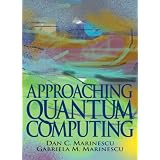
Average Reviews:

(More customer reviews)There are a number of good books about quantum computing around. Unfortunately, because it has a number of errors, and because the explanations are not always clear, this is not one of them. I know somebody who, after reading this book's section on superdense coding and teleportation, ended up more confused than he started out. This is because not only is teleportation presented using a forest of bewildering 8x8 matrices (correct, but only useful if this is explained well), but the words accompanying these matrices are actually wrong. For example in superdense coding Alice is said to send Bob a quantum bit in a state described by a 4-dimensional vector. This vector actually describes the joint state of Alice and Bob's quantum bits, and there is no way to describe Alice's quantum bit alone. This is a very important distinction to make if you want to comprehend the material, and this book does not make it here. We also learn that in teleportation, "The transfer of quantum information appears to happen instantly, though Bob needs to first receive classical information regarding the result of Alice's measurement before validating his own result." I'm not even sure what this sentence is trying to say. What does validating mean in this context?
The definition of uniformity is wrong. The authors do not appear to understand the concepts behind this definition, or if they do, they are incapable of communicating these concepts to the reader.
In the factoring algorithm, the second condition in the definition of order of r modulo N is incorrect. First it has a 1 in the right-hand-side, and the authors meant to put a 0 there. Second, this condition does not belong in the correct mathematical definition of order. And finally, they don't need this condition since they don't seem to use it anywhere. To make matters worse, Figure 5.10, which illustrates the factorization process for 21, shows 1 times 11 being equal to 16.
To be fair to the authors, these errors have now been corrected in the errata, and I haven't looked at earlier chapters of the book, which may be better than the chapters I did look at.
Click Here to see more reviews about: Approaching Quantum Computing
With a clear writing style and matter-of-fact approach, this rigorous yet accessible introduction to quantum computing is designed for readers with a solid mathematical background but limited knowledge of physics and quantum mechanics. Using a methodical approach and an abundance of worked examples, this handbook delivers a thorough introduction to the quantum circuit model, including the mathematical formalism required for quantum computing. Concentrates on the quantum circuit model to make complex subject matter more accessible. Provides a phenomenological introduction to quantum computing, encouraging readers to view the subject as a fundamentally new approach to computing. Detailed presentation of quantum algorithms demonstrates the logic behind the development of Deutsch's problem, quantum Fourier transform, Shor's factoring algorithm, Simon's algorithm for phase estimation, and discrete logarithms evaluation problems. For anyone interested in learning more about quantum computing.

Click here for more information about Approaching Quantum Computing

0 comments:
Post a Comment