Average Reviews:

(More customer reviews)Hi! I am student in the University of Texas at Austin majoring in Computer Science. I am using this book for my C++ progamming class. The book starts with simple things and builds up. Each chapter is nicely divided in subsections. Each and every section has an example and the syntax and format is clearly marked in a different color and this pattern has been consistently followed throughout the book. Each chapter has a section named "Part of the Picture:" which focuses on the application part. This gives me a broader picture about its use and forces me to use C++ in problem solving. Each section has many quick quizes, programming problems which tests my understanding. The authors have consistently followed Object Centered Design and reusable code. One of the authors has included his website where most of the examples are available for many platforms. Students can easily download them and can run them to get a clear picture without wasting time keying into an editor and then compiling it.
Click Here to see more reviews about: C++: An Introduction to Computing (3rd Edition)
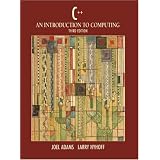
Object-oriented programming is quickly becoming a standard industry practice, and this book exposes the beginner programmer to object-oriented programming early and consistently. Using a "spiral"approach—Central topics are introduced early and are revisited in increasing detail throughout the book. This "use it, then build it"approach exposes users to concepts underlying basic constructs, reducing the learning curve when the time comes to actually build their own. Provides a gradual introduction to classes and object-oriented programming, especially suited for those with previous programming experience. A CD-ROM with every copy of the book includes all the source code for programs in the book. The authors introduce key ideas behind computing with C++ and object-oriented programming in an intuitive and non-intimidating way. This book not only covers text-based programming, but also graphical/internet programming. A new final chapter on Data Structures has been added which provides an introduction to vectors, linked-lists, stacks, queues, and trees, and how they are used in the Standard Template Library (STL). Object-Centered Design, Introductory Example, Spiral Approach, and Standard Template Library (STL) sections have been retained. Good documentation techniques and habits are modeled in examples. "Part of the Picture"sections in each chapter—several contributed by field experts— introduce readers to discipline of Computer Science-e.g., ethics, history, AI, and architecture. Ex. Ch. 1, Ethics and Computing, and Ch. 6, Artificial Intelligence. Appropriate for beginner to intermediate programmers using C++ (CS1 with C++).
 Get 43% OFF
Click here for more information about C++: An Introduction to Computing (3rd Edition)

0 comments:
Post a Comment